Suru Summer Festival 2026: A New Hope for Tourism, But Cultural Balance Is Essential
By Syed Hashim Rizvi
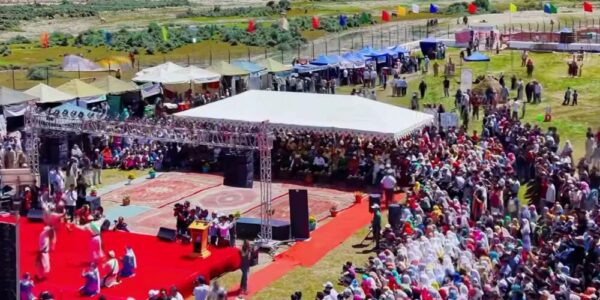
The Suru Summer Festival 2026, held on August 26 and 27 at the picturesque Damsna Spang in Kargil district, has emerged as an important initiative to promote tourism, culture and adventure sports in the Suru Valley. The two-day festival was inaugurated by Dr Mohammad Jaffer Akhoon, Chairman and Chief Executive Councillor of the LAHDC Kargil, and witnessed the participation of a large number of locals as well as domestic and foreign tourists.
The primary objective of the festival was to showcase the natural beauty and tourism potential of the Suru Valley to the country and the world, while promoting adventure activities such as paragliding, river rafting, mountaineering, cycling and skiing.
Set against the natural landscape of Damsna Spang, the festival once again demonstrated the immense potential of Suru Valley for adventure, nature and cultural tourism.
The event featured a range of colourful cultural programmes, while activities such as river rafting, paragliding and mountaineering attracted considerable attention from visitors and tourists. Stalls showcasing traditional local cuisine, handicrafts and objects once used in everyday life provided the younger generation and visitors from outside the region an opportunity to learn about the traditional lifestyle and culture of Ladakh, particularly the Suru region.
One of the biggest strengths of such festivals is that they are not merely platforms for entertainment. They can also create new opportunities for the local economy. Increased tourist footfall can generate employment and income for people associated with hotels, homestays, transport, local food, handicrafts, guiding services and adventure sports.
With appropriate training, the youth of Suru Valley can find employment in paragliding, mountaineering, guiding, river rafting, cycling and other adventure activities. They can also play an important role in establishing the region as a recognised adventure tourism destination.
The promotion of local cuisine and traditional products at the festival was another noteworthy aspect. The success of a tourism festival should not be measured only by the size of its stage, music or entertainment programmes. It should also be judged by how effectively it highlights the local history, culture, language, clothing, food, handicrafts and way of life.
From this perspective, the traditional food and handicraft stalls at Damsna Spang were a positive initiative. However, this aspect deserves greater attention in the future so that the Suru Festival develops an identity not merely as an entertainment event, but as a festival that represents the distinctive culture and heritage of Suru.
At the same time, some of the cultural and entertainment programmes presented during the festival have reportedly raised concerns among sections of Kargil’s religious and social circles. During Friday sermons and other religious gatherings, some clerics and organisations expressed reservations about programmes involving young men and women dancing together, singing and participating in certain other activities, describing them as inconsistent with local religious and social values.
These sections have argued that Kargil has a distinct religious and cultural identity and that, while promoting tourism, the sentiments and social values of the local population must also be taken into consideration. Their concerns have particularly focused on the perception that some entertainment and musical programmes received greater visibility than the adventure activities announced as a central component of the festival.
These concerns, irrespective of one’s position on them, raise an important social question: how can Kargil promote tourism while preserving the region’s religious, social and cultural identity?
The reality is that successful tourist destinations around the world have embraced modern tourism while retaining their distinctive identities. Kargil can also benefit from this approach. Its greatest strength lies not only in its spectacular natural beauty but also in its unique culture, traditions, hospitality and local way of life.
Future editions of the Suru Summer Festival could therefore adopt a model that gives greater prominence to adventure tourism, local culture, traditional arts, handicrafts, cuisine, folk music, historical heritage and the talents of local youth. At the same time, entertainment programmes that may be considered objectionable by a significant section of the local community could be planned with greater sensitivity.
For this purpose, advance consultation among the administration, local religious scholars, civil society, elected representatives, youth, travel operators and cultural organisations could provide a constructive way forward.
Another important dimension of the Suru Festival is the participation of young people. If the administration connects the event with youth training and employment rather than limiting it to a few days of entertainment, its long-term impact could be far greater.
Young people can be trained as mountaineering guides, rafting instructors, paragliding trainers, cycling guides, photographers, digital content creators, travel guides and homestay managers. In this way, the youth of Suru can not only turn the natural beauty of their region into a source of livelihood but also become its genuine ambassadors.
It is equally important to channel the energy of young people towards education, skills, sports, adventure activities and constructive creative pursuits. The festival will have greater meaning when its benefits continue to reach local youth long after the event itself has ended.
The organisation of a two-day festival is a good beginning, but the real challenge lies in turning it into a sustainable and distinctive tourism brand. If the Suru Summer Festival is organised every year with improved planning and places local culture, adventure sports, environmental protection, employment and tourism infrastructure at its centre, it could eventually become one of Kargil’s most important tourism events.
For this to happen, organising the festival alone will not be enough. Greater attention will also have to be given to roads and connectivity, homestays, trained tourist guides, rescue and medical facilities, safety arrangements for adventure sports, cleanliness, waste management and environmental conservation.
Overall, the Suru Summer Festival 2026 can be viewed as a positive step towards promoting tourism in the Suru Valley. It provided a platform to showcase the region’s natural beauty, adventure tourism potential and local culture. However, the religious and social concerns raised over some of the programmes should not simply be dismissed as opposition.
A successful festival is one that attracts tourists while also taking the local community along with it. By recognising Kargil’s religious and social sensitivities and the cultural identity of Suru, the region can promote modern tourism activities without losing sight of its roots.
The need of the hour, therefore, is to ensure that the Suru Summer Festival does not become a subject of political or religious controversy. Instead, it should evolve into a platform where tourism and culture, development and tradition, youth employment and local values are not seen as competing interests, but as complementary pillars of sustainable growth.
If the administration and local community succeed in maintaining this balance, the Suru Summer Festival could grow beyond being an annual entertainment event and become a strong foundation for sustainable tourism development and economic opportunities in the Suru Valley.
0 Comments