Indian Civil Society and Religious Leaders Convene to Condemn Global Injustice and Mourn Iranian Leadership
By: Anzarul Bari Rafiqui
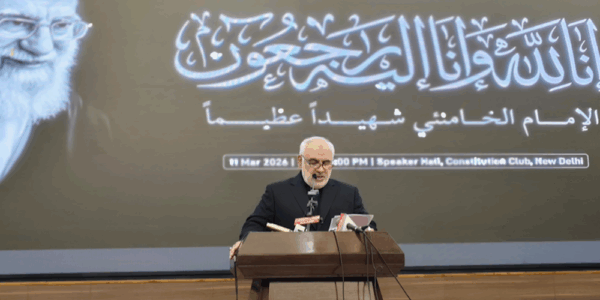
VOL News Desk/ The condolence meeting held at the Constitution Club in New Delhi recently became far more than a ceremonial tribute to the late Supreme Leader of Iran, Ayatollah Ali Khamenei. What unfolded instead was a powerful convergence of political leaders, diplomats, religious figures, academics, and civil society representatives who came together to reflect on the implications of a widening geopolitical conflict and the moral responsibilities that accompany it. Organized jointly by Indian Muslims for Civil Rights (IMCR) and the Association for Protection of Civil Rights (APCR), the gathering served as a forum where grief, political criticism, humanitarian concern, and calls for international accountability intersected.
Participants represented a broad spectrum of Indian public life. Leaders from multiple faith traditions, former government officials, parliamentarians, scholars, and social activists shared the stage, demonstrating that the event was not limited to a single ideological or religious constituency. Instead, it presented itself as a collective moral response to what many speakers described as an alarming escalation of violence in the Middle East and a moment demanding reflection on international law, sovereignty, and humanitarian values.
Representing the Iranian diplomatic mission, Ambassador Dr. Mohammad Fathli addressed the audience with a message that blended gratitude with sorrow. He conveyed the Iranian government’s appreciation for the expressions of sympathy emerging from various sections of Indian society. According to the ambassador, the conflict confronting Iran was not initiated by Tehran but imposed upon it. He described a scenario in which diplomatic engagement had been underway, including negotiations involving the United States and Israel, before military hostilities abruptly erupted. In his account, those negotiations collapsed through betrayal, culminating in an attack that claimed the life of Iran’s Supreme Leader along with numerous civilians.
* Click to Follow Voice of Ladakh on WhatsApp *
Dr. Fathli also highlighted the human cost of the violence, pointing to incidents in which educational institutions were reportedly targeted. Among the victims, he said, were schoolgirls whose deaths symbolized the tragic consequences of modern warfare when civilian spaces become battlefields. Despite the devastation, he insisted that Iran’s military response had been limited to strategic installations linked to American and Israeli forces, reiterating Tehran’s claim that it does not intentionally target non-combatants.
The ambassador framed Iran’s actions as defensive rather than aggressive, arguing that the country is acting to preserve its sovereignty and protect its citizens.
The emotional weight of the gathering was amplified by the voices of Indian political leaders who used the occasion to articulate broader concerns about global diplomacy and India’s own foreign policy posture. Mohammad Adeeb, former Member of Parliament and president of IMCR, invoked India’s legacy as the land of Mahatma Gandhi, a nation historically associated with non-violence and mediation. Adeeb expressed disappointment over what he described as growing proximity between New Delhi
and Tel Aviv, arguing that such alignment contradicts the spirit of independent diplomacy traditionally associated with India’s international role. In strong language, he characterized Israel’s leadership as responsible for grave violations and suggested that public displays of camaraderie between political leaders carry symbolic weight that cannot be ignored.
Echoing concerns about global justice, Salman Khurshid— former External Affairs Minister and president of the India Islamic Cultural Centre—condemned the military actions directed against Iran. Khurshid explained that members of the All India Congress Committee had already visited the Iranian Embassy in New Delhi to convey their condolences and express solidarity with the Iranian people. He also indicated that the India Islamic Cultural Centre would undertake a similar gesture, underscoring the importance of diplomatic and humanitarian outreach during moments of international tragedy.
For Khurshid, the central issue was not merely geopolitical rivalry but the broader question of justice. He emphasized that his political organization rejects forces that propagate violence or destabilization across the world. The remarks positioned the crisis as part of a larger debate about how nations respond when principles of international law appear to be challenged by military power.
Former Lieutenant Governor of Delhi Najeeb Jung approached the matter from a historical perspective. He reminded the audience that Iran has long been regarded as an important regional partner for India, connected through centuries of cultural exchange, trade, and diplomatic cooperation. Jung argued that the attacks against Iran by the United States and Israel deserved unequivocal condemnation. He expressed particular concern over reports suggesting that civilian populations had suffered during the conflict. According to him, the apparent reluctance of the Indian government to issue a clear public statement on the killing of Iran’s Supreme Leader was deeply troubling.
Another voice adding intellectual weight to the discussion was Professor Manoj Jha, a Member of Parliament known for his academic background and engagement with social issues. Jha criticized what he described as the central government’s silence regarding the crisis. In his remarks, he portrayed Ayatollah Ali Khamenei as a leader who demonstrated resolve in the face of adversity, suggesting that the Iranian leader chose resistance over capitulation. While expressing solidarity with the Iranian people, Jha framed the situation as a moment that tests the ethical commitments of nations that claim to uphold democratic values and human rights.
Religious leaders present at the gathering also offered perspectives that transcended political debate. Engineer Syed Saadatullah Hussaini, Ameer of Jamaat-e-Islami Hind, focused on the international legal implications of the conflict. He argued that the military action undertaken by the United States and Israel represented a direct challenge to established principles governing relations between sovereign states. Hussaini warned that repeated violations of international law risk weakening the authority of global institutions designed to prevent conflict and maintain stability.
From a judicial viewpoint, former judge Justice Iqbal Ansari described the unfolding situation as evidence of a profound crisis in the global order. In his assessment, the attack on Iran demonstrated how geopolitical power dynamics can override established norms of international conduct. Ansari portrayed the death of Ayatollah Khamenei as an event that would be remembered not merely as a political development but as a moment illustrating the courage associated with leadership under pressure.
Academic voices also contributed analytical depth to the discussion. Vipin Kumar Tripathi, professor emeritus at the Indian Institute of Technology Delhi, described the military confrontation as a dangerous escalation imposed without provocation. Referring to the events of February 28, 2026, he alleged that the initial strikes resulted in the deaths of numerous senior officials as well as civilians, including schoolchildren. Tripathi characterized the episode as an illustration of the brutal principle that power often overrides law in international affairs. In his view, such actions represent a direct assault on the concepts of national sovereignty and political independence that underpin the modern state system.
Among the most outspoken participants was prominent lawyer and activist Prashant Bhushan. Known for his advocacy on constitutional and civil rights issues, Bhushan described the attack on Iran as deeply disturbing. He expressed concern over what he perceived as a shift in India’s foreign policy orientation toward closer alignment with Israel and the United States. Questioning the timing of a recent meeting between Prime Minister Narendra Modi and Israeli Prime Minister Benjamin Netanyahu shortly before the escalation of hostilities, Bhushan suggested that India’s leadership appeared to be prioritizing strategic partnerships over its traditional non-aligned stance.
For Bhushan, the central issue was the preservation of India’s independent diplomatic voice. He argued that historically, India maintained a balanced approach in global conflicts, often advocating dialogue and restraint rather than choosing sides in geopolitical confrontations. According to him, the current trajectory risks undermining that legacy. Despite his criticism of official policy, he emphasized that many ordinary Indians continue to sympathize with the Iranian people and share in their grief over the reported killing of their Supreme Leader.
Significantly, the meeting was not confined to Muslim voices. Goswami Sushil Ji Maharaj, chief of the Sarva Dharma Sansad and a respected figure within Sanatan Dharma circles, emphasized the importance of unity among followers of different faiths. He argued that the first duty of religion is humanity itself. By condemning the violence and expressing solidarity with Iran, Maharaj sought to underline that moral concerns about war transcend religious boundaries. His remarks reinforced the broader message that compassion and justice should guide the response of global societies to humanitarian crises.
Several other distinguished personalities addressed the gathering, including former Member of Parliament Kunwar Danish Ali, social activist Father John Dayal, Dharmik Jan Morcha national president Mohammad Saleem Engineer, former ambassador Ashok Kumar Sharma, and former Planning Commission member Syeda Hameed. Each contributed perspectives that underscored the meeting’s central themes: humanitarian concern, respect for sovereignty, and the urgent need for renewed commitment to international law.
The program was moderated by social activist Nadeem Khan, whose role helped guide the discussion through its various phases. The concluding remarks were delivered by IMCR General Secretary Masood Hussain, who emphasized that the issue at stake extends beyond the loss of individual lives. According to Hussain, what is ultimately being defended is the dignity of human existence itself. He called upon civil society to raise its voice against injustice and to demand accountability wherever violations occur.
In its final declaration, the gathering articulated several demands. Participants called for an immediate halt to military aggression, restoration of respect for international legal frameworks, and recognition of the rights and sovereignty of the Iranian nation. The statement also urged India to reaffirm its historic commitment to justice and independent diplomacy on the world stage.
The condolence meeting at the Constitution Club thus evolved into a broader reflection on the moral and political responsibilities of nations during times of conflict. While the immediate purpose of the event was to mourn the reported death of Iran’s Supreme Leader, the discussions that unfolded revealed deeper anxieties about the direction of global politics. At its core, the gathering represented a collective appeal for humanity, dignity, and justice—values that transcend national boundaries and ideological divisions.
In a world increasingly defined by strategic rivalries and military confrontations, the voices heard in New Delhi served as a reminder that civil society continues to demand accountability and compassion from those who wield power. Whether or not those demands translate into policy change remains uncertain. Yet the very act of speaking out, as the participants emphasized, is itself an affirmation that conscience still holds a place in international discourse.
0 Comments