Farming on the Edge: Climate-Resilient Agriculture in India’s Fragile Himalayan Regions
Biju Dharmapalan
India’s agricultural landscape stands at a critical crossroads. Unpredictable and erratic
monsoons, prolonged droughts, unseasonal rainfall, and increasing pest outbreaks are no
longer anomalies—they are becoming the norm. Against this backdrop, farming that is
resilient to the impacts of climate is not a political option, but a national need in this changing
environment. Its effects are far more extensive than harvests and may define the future of
food security, the livelihoods of farmers, and the ecological sustainability of the whole
country, worst of all in those areas at risk, such as the North-East.
Recent reports indicate that almost half of India’s agricultural districts are highly susceptible
to climate change. What stands out in this harsh reality is the fact that the Indian food system
is facing a bigger crisis: it is strained to its core. Millions of livelihoods and over a billion
people depend on agriculture, but agriculture is becoming more vulnerable to climatic
uncertainties. Realising this, organisations such as the Indian Council of Agricultural
Research, through initiatives such as the National Innovations in Climate Resilient
Agriculture, have started redefining agricultural strategy in India.
Emphasis has moved away to maximising production in favour of stability, flexibility and
sustainability. In this respect, climate-resilient farming can be distinguished as both a
defensive and transformative response. It aims to protect agriculture against climatic shocks,
but it also redefines how farming is conducted. The key component of this change is
localisation. The drafting of the District Agriculture Contingency Plans across all agricultural
districts represents a significant break with the homogeneity of policy frameworks and a shift
towards contextualised solutions.
The risks faced by the climate in India vary across different states. Adaptation is made more
effective by specific choices and strategies in crop selection, farming, and resource
management adjusted to local conditions. No less important is the redesign of climate-
resistant crop varieties. There are thousands of new drought, flood, pest, and temperature-
stressed-tolerant varieties released in the past decade. These scientific discoveries play a vital
role in balancing the yields in adverse weather conditions. To farmers, it means they will be
reducing the risk; to the country, they are guaranteeing a more stable food supply.
The idea of resilience, however, should not be confined to research centres. Only when it
reaches farmers it will only succeed. The Climate Resilient Villages programmes and
capacity-building programmes under ICAR-Krishi Vigyan Kendra’s have been very
significant in filling this gap. The practice training, which helps farmers build resilience to
climate change by promoting seed banking, water conservation, and crop diversification, is
underway. The introduction of digital technologies to this ecosystem also strengthens it.
Artificial intelligence, real-time weather minute, and pest surveillance system is transforming
the extent of decision-making at the farm level. Information that is timely and correct about
the weather at a time when the climate is uncertain can prove the difference between a
successful and unsuccessful crop. The effects of such intervention on food security are
severe. Traditionally food security has been associated with availability i.e. production of
sufficient amount to meet demand. The idea of climate change, however, introduces a certain
element of volatility, which introduces a twist to this equation. The risk factors related to food
access are crop failures, supply chain issues, as well as price change, especially among the
vulnerable groups of the population.
Among the solutions through which climate-resilient farming can contribute to solving this is
by guaranteeing the continuation of production, with the aim of safeguarding its availability,
affordability and accessibility. These issues are even more acute in the vulnerable Himalayan
states of Ladakh and Kashmir, where the effects of climate change are particularly dramatic.
These mountaintop environments are experiencing the swift retreat of glaciers, diminished
snow cover, and an increase in the unpredictability of precipitation events. The dependence of
agriculture on the melting of glaciers is very high in this region, hence it is very sensitive to
any variation in the natural water cycles.
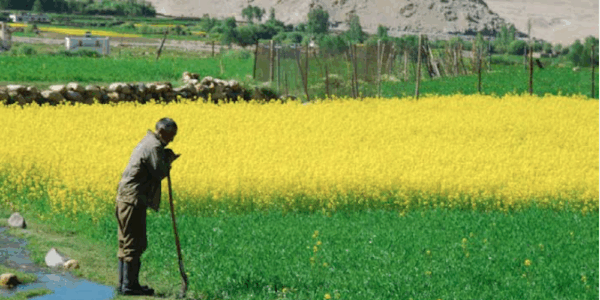
In Ladakh, where the growing period is limited and the water shortage is severe, new
solutions like artificial glaciers and ice stupas have become essential solutions. Agricultural
activity is being sustained through traditional water management systems, such as zings, in
combination with modern interventions, such as drip irrigation and covered farming in poly
houses. Planting of short-grown and cold-tough varieties of crops is also becoming
significant.
The pattern of changing snowfall and unseasonal rainfall, among other factors, is affecting
the agriculture and horticulture, especially apple farming, a mainstay of the rural economy in
Kashmir. Horticultural techniques that are resistant to the impacts of climate change,
improved prediction methods, and the need for alternative crops are becoming necessary to
protect lives.
Landslides, soil erosion, and loss of fertile land are also challenges encountered in the
Himalayan terrain due to extreme weather. Terracing, agroforestry, and organic farming are
also sustainable practices essential in improving resilience as well as maintaining ecological
equilibrium. It is also important to empower local food systems because food supply chains
in these areas are often hindered by geographic distance and adverse weather conditions.
Outside the farming sector, there are socio-economic consequences. Agricultural resilience to
climate will stabilise incomes, alleviate rural poverty, and prevent rural-urban migration. It is
also capable of motivating young people to stick with the farming sector as an industry rather
than a risky business. This also has an environmental dividend. The Himalayan region is a
globally significant biodiversity hotspot and a critical ecosystem, and the numerous climate-
resilient practices, including mixed farming and less frequent use of chemicals, help conserve
biodiversity. This not only conserves ecosystems but also increases agricultural sustainability
in the long term.
Although it promises to be a good change, the switch to climate-resilient farming is fraught
with problems. Access to resources, credit, and information is not usually available to small
and marginal farmers. The implementation is further complicated by the lack of infrastructure
in remote areas. Such concerns will need specific policy assistance, more investment, and
better institutions to resolve them.
In conclusion, climate-friendly agriculture is a paradigm shift in the way agriculture is
practised in India. It goes beyond its narrow view of productivity to embrace resilience,
sustainability, and inclusivity. As a diverse and populous country like India, this necessary
transition will help ensure the future of Indian food systems. Since climate change has begun
to alter the agricultural landscape, the question is not whether India can afford to invest in
climate-resilient agriculture, but whether it can afford not to. The future of India’s food
security—and indeed its socio-economic stability—depends on the answer.
Disclaimer: The views expressed in the article are those of the author and doesn’t necessarily reflects the editorial policy of Voice of Ladakh.
0 Comments