Land Allocation and Construction of Haj House in Leh: A Longstanding Community Demand

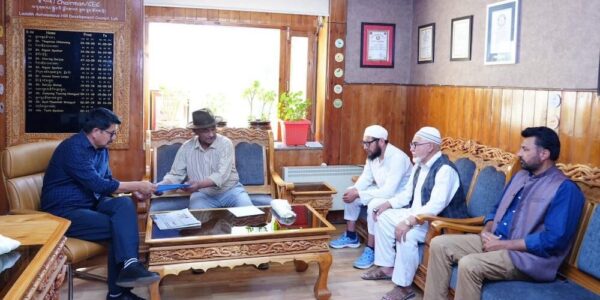
Ladakh, a land of high mountains and deep-rooted traditions, has entered a new chapter since its separation from Jammu and Kashmir and its recognition as a Union Territory in 2019. While the transition has brought promises of direct governance, accelerated development, and stronger regional identity, it has also placed before the administration the challenge of ensuring inclusivity and equal recognition for its diverse communities. The recent meeting between Hon’ble CEC, LAHDC Leh, Adv. Tashi Gyalson, and a delegation of Muslim religious leaders is emblematic of this responsibility.
The delegation—comprising Hajj Committee member Haji Nazir Ahmed, Executive Member of Anjuman Noorbaksh Haji Shamsher Ali, Naib Imam of Jama Masjid Leh Inayat Ali, and former Anjuman Imamia Leh member Amjad Hussain Zubdavi—brought forth an issue that resonates deeply with the Muslim community of Ladakh: the immediate allocation of land and construction of a Haj House along with the establishment of a Haj Committee branch office in Leh. Their demand was expressed not as a new wish but as a longstanding aspiration, one that has only gained urgency in the new governance framework of Ladakh.
Why the Haj House Matters
* Click to Follow Voice of Ladakh on WhatsApp *
The call for a Haj House is not simply about bricks and mortar. It is about recognition, dignity, and logistical necessity. Every year, hundreds of Muslims from Ladakh embark on the Haj pilgrimage, one of the most significant spiritual journeys in Islam. For a region as remote and geographically challenging as Ladakh, the process of preparing for Haj—from paperwork to travel arrangements—has always been a formidable challenge.
In the absence of a local Haj House or office, aspirants have often had to rely on distant facilities, adding to financial, logistical, and emotional burdens. Winters in Ladakh, with blocked roads and limited flights, compound these difficulties. For elderly pilgrims, who form a significant section of Haj applicants, these challenges can often prove overwhelming.
A Haj House in Leh would serve multiple purposes: a center for orientation and guidance, a hub for documentation and administrative facilitation, and a shelter for pilgrims before embarking on their journey. More importantly, it would stand as a symbol of respect and recognition of the Muslim community’s cultural and religious needs within Ladakh.
Ladakh’s New Governance Reality
The separation of Ladakh from Jammu and Kashmir was intended to give the region a more direct voice in its governance. However, this also meant that facilities previously accessible in Srinagar or Jammu are no longer within easy reach. The Haj Committee, which once functioned under the state structure of J&K, has now been reorganized under the Union Territory framework. While its establishment in Ladakh was welcomed, the absence of supporting infrastructure like a Haj House in Leh continues to be a glaring gap.
The delegation rightly pointed out that if Ladakh is to function as an independent Union Territory, it must also provide for the institutional needs of all its communities locally, without expecting them to depend on neighboring regions. The Haj House is therefore not just an administrative demand—it is a litmus test of Ladakh’s ability to govern inclusively.
The meeting between CEC Tashi Gyalson and the Muslim religious delegation is a positive step, but it must not remain confined to words of assurance. The administration must act swiftly to allocate land and initiate the construction of the Haj House and Haj Committee office in Leh. Doing so will ease the logistical hardships of pilgrims, fulfill a long-pending community aspiration, and reinforce the principle that Ladakh’s governance is rooted in fairness and inclusivity

0 Comments