Kargil Forest Division to Prepare Its First Working Plan Since 1979
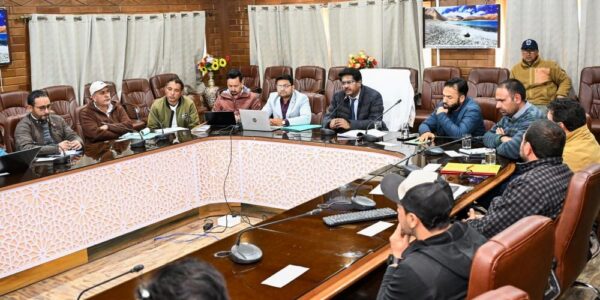
Kargil, October 29/VOL News Desk/ The Forest Department, Ladakh, held a stakeholder consultation meeting at the Conference Hall, Baroo, Kargil, on Thursday to gather technical inputs and recommendations for preparing the first Working Plan of Kargil Forest Division since its establishment in 1979.
The meeting was chaired by the Additional Principal Chief Conservator of Forests (APCCF), Ladakh, and attended by representatives of various government departments, the University of Ladakh, Survey of India, WWF, Himalayan Brown Bear Trust and other stakeholders.
Addressing the meeting, the APCCF emphasised the need for scientific forest management, accurate land records, forest mapping, biodiversity conservation and sustainable utilisation of natural resources. He highlighted Ladakh’s limited forest cover and stressed the importance of protecting existing vegetation while enhancing tree cover in ecologically suitable areas.
* Click to Follow Voice of Ladakh on WhatsApp *
The proposed Working Plan will cover forest resource assessment, land classification, biodiversity, plantation development, forest protection, infrastructure, agroforestry and sustainable timber production. It will also examine the management and conservation of sea buckthorn, community participation and climate-responsive approaches suited to Ladakh’s fragile high-altitude environment.
The Divisional Forest Officer/Wildlife Warden, Kargil, outlined the proposed structure of the Working Plan, comprising a general description of the division and a management plan with scientific prescriptions. Departments and institutions were requested to provide relevant land records, maps, soil data, vegetation inventories, wildlife information and research findings.
The University of Ladakh offered technical support in documenting local flora, biodiversity and soil characteristics, while its Geography Department highlighted the use of Geographic Information Systems (GIS) and remote sensing for forest mapping and monitoring. Forest Survey of India also assured assistance with available maps and spatial information.
The Agriculture Department stressed the need to promote agroforestry and improve the availability of quality poplar planting material. The meeting also discussed plantation survival, tree-cover enhancement and convergence with relevant government schemes.
The Animal Husbandry Department highlighted fodder shortages, inadequate grazing pastures and the need to assess livestock grazing pressure, particularly in Drass and the Suru Valley. Measures for pasture improvement, fodder development and mitigation of human-wildlife conflict were also discussed.
Representatives of the Himalayan Brown Bear Trust and WWF highlighted community-based conservation, wildlife conflict mitigation, biodiversity documentation and the identification of wildlife hotspots. The meeting also discussed sea buckthorn management and opportunities to link conservation activities with local livelihoods and employment-generation programmes.
Technical presentations on Biodiversity Management Committees, People’s Biodiversity Registers and Normalized Difference Vegetation Index (NDVI) analysis highlighted the role of community participation, satellite data and scientific monitoring in preparing the Working Plan.
The APCCF stressed that the plan should integrate ecological conservation with local livelihood needs through interdepartmental coordination, reliable scientific data and field verification. The inputs received during the meeting will be examined for incorporation into the Working Plan, subject to applicable legal provisions and technical requirements.
0 Comments