New Political Crisis in Hill Council Kargil as Four BJP Councillors Resign
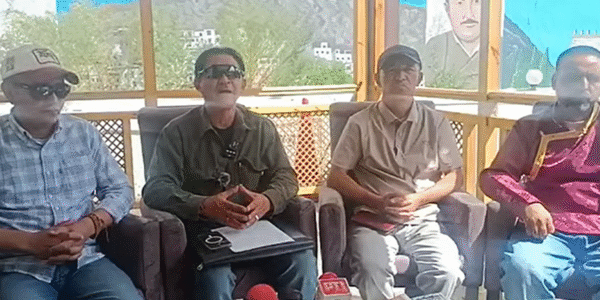
VOL News Desk/ The Ladakh Autonomous Hill Development Council (LAHDC) Kargil has once again entered a political crisis after four councillors affiliated with the Bharatiya Janata Party (BJP) formally submitted their resignations to the office of the Chief Executive Councillor (CEC) on September 7.
The resignations have changed the political equations within the Hill Council and raised serious questions about the future of the present council and the position of CEC Dr. Mohammad Jaffer Akhoon. The key question now is how Dr. Jaffer Akhoon will prove and maintain his majority in the Council.
According to sources, the four resigned councillors belong to the Zanskar and Shum areas. Their resignations have altered the existing political alignment and the numbers supporting the CEC, creating fresh uncertainty over the continuation of Dr. Jaffer Akhoon’s leadership.
* Click to Follow Voice of Ladakh on WhatsApp *
The development comes at a time when the Union Territory administration of Ladakh has recently issued a notification concerning the establishment of Ladakh Autonomous Hill Development Councils in all seven districts of Ladakh. Even before the resignations, there had been political speculation among political circles and the public regarding the tenure and future of the present Kargil Hill Council. The resignation of four councillors has made the situation more complicated.
Following the elections to the Fifth LAHDC Kargil, the National Conference (NC) and Congress had reached a political power-sharing agreement under which both parties were to lead the Council for two-and-a-half years each.
Under that arrangement, the National Conference initially took control of the Council, and Dr. Mohammad Jaffer Akhoon was appointed Chief Executive Councillor. The NC’s two-and-a-half-year period ended in April this year. According to the power-sharing agreement, the leadership was then expected to pass to the Congress.
However, Dr. Jaffer Akhoon refused to step down from the position of CEC. This led to an escalation of political differences within LAHDC Kargil. Congress withdrew its support from him and accused him of violating the power-sharing agreement. Some National Conference councillors also withdrew their support.
The National Conference’s senior leadership subsequently took disciplinary action against Dr. Jaffer Akhoon and expelled him from the party for six years, reportedly for violating the decision of the party high command.
Despite the political crisis, Dr. Jaffer Akhoon managed to retain his position as CEC. He was reported to have the support of 15 councillors, including BJP councillors, some National Conference councillors, one Congress councillor and one Independent councillor. On the basis of this claimed support, he continued as Chief Executive Councillor.
However, the resignation of four BJP councillors has once again changed the political arithmetic. Under the current situation, Dr. Jaffer Akhoon is reportedly left with the support of around 11 councillors. This has raised new questions about whether he still commands a majority in the Council and whether he can continue as CEC.
The biggest question following the four resignations is whether the present Hill Council will complete its scheduled term or whether the ongoing political crisis could eventually lead to its dissolution before the completion of its tenure.
It will also be important to see what the Council’s actual numerical strength becomes after the resignations, whether the resignations are formally accepted, and what political strategy Dr. Jaffer Akhoon adopts in the coming days to retain his majority.
For now, the resignation of the four BJP councillors has opened a new chapter in Kargil’s political affairs. Further political realignments, possible alliances, additional resignations, acceptance of the resignations and decisions by the Ladakh administration will determine whether Dr. Jaffer Akhoon succeeds in retaining the CEC’s position or whether the Fifth Hill Council enters a new political phase before completing its scheduled term.
0 Comments