The Women Who Hold the Mountains Together
Adv Sonam Wangdus
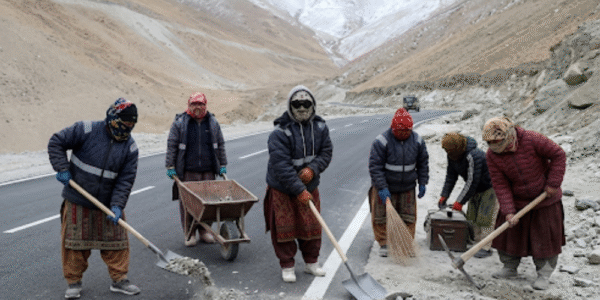
VOL News Desk/ Anyone who has travelled the high-altitude highways of Ladakh has seen them, even if only in passing. I have spent years framing the austere beauty of the Himalayas through my camera lens. Again and again, my eye is drawn not to the mountains themselves, but to the figures working quietly in the foreground. Against the immensity of the landscape, they appear almost insignificant, small silhouettes bent over shovels, brooms and pickaxes. Yet it is their labour that keeps these mountains connected. Most are women from nearby villages. Their faces are wrapped tightly in woollen scarves against the biting wind. They stand on narrow mountain roads carved into sheer cliffs, where a single misstep could mean a fall into the gorge below.
In summer, they clear rocks loosened by melting snow and unstable slopes before they can block the highway. During the brief but intense monsoon, they scoop icy water from potholes with plastic containers to prevent further damage to the road surface. In winter, while much of Ladakh still sleeps, they scatter soil and grit across frozen stretches of asphalt so that military convoys, ambulances and civilian vehicles can pass safely. Their workplace lies at elevations that frequently exceed 15,000 feet, where the air is thin, the weather unpredictable and the landscape unforgiving. Every day they work under the constant risk of landslides, falling rocks, speeding traffic and sub-zero temperatures. Few travellers know their names. Fewer still understand the conditions under which they work.
Many of these workers are engaged as Casual Paid Labourers (CPLs) under projects executed by the Border Roads Organisation (BRO), the agency responsible for constructing and maintaining some of India’s most strategically important roads. Their labour forms the invisible foundation of Ladakh’s connectivity. Every tourist who reaches Pangong Lake, every truck carrying food and fuel, every ambulance travelling to a remote village and every military convoy heading towards the frontier depends, in some measure, upon their work. Yet the economic reality experienced by many workers stands in stark contrast to the prosperity their labour sustains.
Ladakh’s tourism industry has grown into a significant contributor to the region’s economy. A single taxi excursion from Leh to Pangong Lake can cost well over ₹10,000, while hotels and luxury camps routinely charge several thousand rupees for a night’s stay during the tourist season. These businesses rely upon roads that remain open despite landslides, snowstorms and rapidly changing weather. The people who maintain those roads, however, often remain among the least visible participants in that economic ecosystem.
The story of these women is also the story of a changing Ladakh. For generations, families depended upon agriculture and pastoralism. Barley fields, livestock and seasonal cultivation shaped both the economy and everyday life. Today, however, farming has become increasingly uncertain. Climate variability, changing consumption patterns and the availability of subsidised food grains have altered the economics of rural livelihoods. At the same time, tourism, construction and infrastructure development have created new opportunities for wage employment. For many households, road maintenance is no longer a temporary occupation but an economic necessity. The women who once spent their days tending fields now spend them clearing highways. Their work reflects not only resilience but also the profound transformation of Ladakh’s social and economic landscape.
* Click to Follow Voice of Ladakh on WhatsApp *
This transformation raises questions that extend beyond economics. It raises questions of law, dignity and constitutional responsibility. Article 21 of the Constitution of India guarantees every person the right to life and personal liberty. Over the decades, the Supreme Court has interpreted this guarantee to include the right to live with dignity and to work under conditions that do not unnecessarily endanger life or health. The Directive Principles of State Policy further require the State to secure humane conditions of work and to protect the health and strength of workers. These constitutional ideals are reinforced by modern labour legislation.
The Occupational Safety, Health and Working Conditions Code, 2020 establishes obligations relating to workplace safety, welfare facilities, working hours and occupational health. The Code on Social Security, 2020 seeks to expand access to welfare benefits, while the Employees’ Compensation Act, 1923 provides compensation where injury or death arises out of employment. For workers operating in one of the harshest environments in the country, these protections are not abstract legal principles. They are matters of everyday survival.
The Ministry of Defence has recognised the extraordinary nature of work performed in high-altitude border regions. Official policy provides for wages linked to notified minimum wages, accommodation, medical treatment, transportation, protective clothing, drinking water, sanitation facilities and compensation where death or disability occurs in the course of employment. Additional provisions, including free ration and kerosene, are available in certain super high-altitude locations. On paper, the framework is comprehensive. The continuing challenge lies in ensuring that these protections reach every worker, at every worksite, across thousands of kilometres of remote mountain roads. Anyone who has travelled extensively through Ladakh has likely observed maintenance crews working in extremely difficult conditions. Such observations do not, by themselves, establish that statutory protections are absent. They do, however, raise legitimate questions about the consistency of implementation, the adequacy of supervision and the effectiveness of enforcement mechanisms in some of the country’s most inaccessible workplaces. Bridging the gap between legal entitlement and practical reality is ultimately a question of governance rather than legislation.
Labour rights also depend upon the nature of employment itself. There is a concerns about the repeated use of short-term contracts that prevent labourers from acquiring the continuity of service required for certain statutory benefits. Where such practices occur, they merit careful scrutiny by labour authorities because the purpose of labour legislation is not merely to regulate employment but to prevent precisely this kind of insecurity. As the principal employer, the Border Roads Organisation bears statutory responsibilities under labour law, including ensuring compliance by contractors engaged on its projects. The legal obligations owed to workers cannot
be avoided simply because work is performed through an intermediary. The question is not whether contractors should be accountable. They must be. The equally important question is whether accountability mechanisms are functioning effectively enough to protect those working in some of the most hazardous conditions in the country.
The roads of Ladakh are often celebrated as engineering achievements. They deserve that recognition. But engineering alone does not keep a mountain highway open. Every day, human hands remove the rocks, clear the snow, repair the drains and restore the road after another night’s assault by the mountains. National security depends upon these roads. Tourism depends upon these roads. Local communities depend upon these roads. And those roads, in turn, depend upon people whose contribution remains largely invisible.
Perhaps the first step towards justice is not another law or another policy. It is recognition. The next time you pass a road maintenance crew working against the wind beneath the vast Himalayan sky, slow down. Look beyond the machinery. Look beyond the road. See the people who make the journey possible. Offer a smile. Offer a nod. Say, “Jullay.” It is a small gesture, but every journey begins with acknowledging the people who made it possible.
Disclaimer: The views expressed in the article are those of the author and doesn’t necessarily reflects the editorial policy of Voice of Ladakh.
1 Comments
Leave a Reply
Well written piece!