CEC Kargil Attends Training-cum-Awareness Programme on Conservation & Registration of Niche-Specific Arid Crops & Farmers’ Varieties
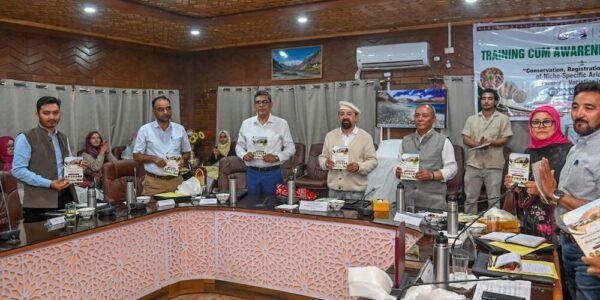
Kargil, July 07, 2026/ VOL News Desk/ Chairman/Chief Executive Councillor, LAHDC Kargil, Dr. Mohd Jaffer Akhoon, today attended a one-day Training-cum-Awareness Programme on “Conservation, Registration and Promotion of Niche-Specific Arid Crops and Farmers’ Varieties in Ladakh” as the Chief Guest at the Conference Hall, Baroo. The programme was organized by the School of Horticulture Science & Technology (SHS&T), University of Ladakh, Kargil, under the Protection of Plant Varieties and Farmers’ Rights (PPV&FR) Authority.
The programme was attended by Vice Chancellor, University of Ladakh, Prof. Saket Kushwaha (virtually), Director Horticulture, Tsering Punchok, Chief Horticulture Officer, Ali Raza, Dr. Faizan Ahmad (KVK Kargil), Assistant Soil Conservator Mohammad Hussain, Head, KVK Kargil, Dr. Nasreen Fatima, Head, KVK Zanskar, Dr. Mohammad Mehdi, faculty members, scientists, researchers, officials from the Agriculture and Horticulture Departments, progressive farmers, students, and other stakeholders.
Welcoming the participants, Dr. Faizan Ahmad highlighted the objectives of the programme and underscored the importance of conserving Ladakh’s rich agricultural biodiversity. He emphasized that proper documentation and registration of indigenous crop varieties would safeguard farmers’ rights while preserving the region’s valuable genetic resources for future generations.
* Click to Follow Voice of Ladakh on WhatsApp *
Delivering the keynote presentation, Dr. Mahrukh provided a comprehensive overview of the Protection of Plant Varieties and Farmers’ Rights (PPV&FR) Act, 2001, explaining its objectives, provisions, and the process for registration of farmers’ varieties. He highlighted the immense genetic wealth of Ladakh and stressed the urgent need to conserve and promote the region’s niche-specific arid crops adapted to its unique cold-arid ecosystem.
During the technical sessions, scientists and subject experts elaborated on Ladakh’s distinctive agro-climatic conditions, the significance of preserving traditional crop varieties, and the benefits available to farmers under the PPV&FR Act. They emphasized that conservation of indigenous germplasm is vital for sustainable agriculture, food security, climate resilience, and enhancing farmers’ livelihoods.
Addressing the gathering, Chief Horticulture Officer, Ali Raza spoke extensively on post-harvest management, value addition, and horticulture development, particularly highlighting the growing potential of apricot cultivation in Ladakh. He informed farmers about various government subsidy schemes and encouraged them to adopt scientific practices and maximize the benefits of departmental initiatives.
Director Horticulture Tsering Punchok highlighted the importance of strengthening post-harvest infrastructure, cold-chain facilities, fruit processing units, and value addition to horticultural produce. He assured the farming community of continued departmental support through various schemes aimed at increasing farmers’ income and promoting sustainable horticulture.
Assistant Soil Conservator, Mohammad Hussain explained various government welfare schemes in the local vernacular language and encouraged farmers to form Self-Help Groups (SHGs) to effectively avail benefits under different government programmes.
Head, KVK Kargil, Dr. Nasreen Fatima, highlighted the extension activities, farmer-centric programmes, and scientific interventions being implemented by Krishi Vigyan Kendra to strengthen the agricultural sector and improve farmers’ capacities across the district.
An interactive session was also held during which farmers shared their experiences, discussed challenges faced in agriculture and horticulture, and sought expert guidance on improving productivity, conserving indigenous crop varieties, and accessing government support.
Addressing the gathering as the Chief Guest, Chairman/Chief Executive Councillor, LAHDC Kargil, Dr. Mohd Jaffer Akhoon, emphasized that conserving and promoting Ladakh’s indigenous agricultural heritage is a collective responsibility. He said the region possesses immense potential in agriculture and horticulture due to its naturally organic environment, traditional farming practices, and unique local crop varieties.
The CEC urged farmers to take full advantage of the various government schemes available in the agriculture and horticulture sectors. He observed that Ladakh’s organic and traditional agricultural products possess tremendous nutritional value and market potential, which can significantly improve farmers’ livelihoods. He stressed that such awareness programmes bridge traditional knowledge with modern scientific practices and play a crucial role in empowering the farming community.
Dr. Akhoon assured that LAHDC Kargil would continue extending all possible support to the Agriculture and Horticulture Departments, the University of Ladakh, Krishi Vigyan Kendras, and other institutions working towards strengthening agriculture, horticulture, and farmers’ welfare in the region.
The CEC also expressed his appreciation to Vice Chancellor Prof. Saket Kushwaha for introducing the B.Sc. Agriculture programme at the University of Ladakh and lauded his efforts in promoting agricultural education, research, innovation, and the conservation of Ladakh’s unique organic agricultural resources.
Addressing the programme virtually, Vice Chancellor, University of Ladakh, Prof. Saket Kushwaha, emphasized the immense potential of Ladakh’s indigenous agricultural and horticultural resources and underscored the importance of conserving traditional crop varieties through scientific research and documentation. He said the University of Ladakh remains committed to promoting sustainable agriculture, innovation, and capacity building among farmers by integrating modern scientific approaches with traditional knowledge. Prof. Kushwaha highlighted that the introduction of the B.Sc. Agriculture programme at the University marks a significant step towards developing skilled human resources in the agriculture sector and strengthening research on the unique cold-arid ecosystem of Ladakh. He urged farmers, students, and researchers to work collectively for the conservation, registration, and promotion of farmers’ varieties, adding that such initiatives will not only safeguard Ladakh’s rich agrobiodiversity but also create new livelihood opportunities and enhance the region’s agricultural economy.
The programme concluded with an interactive technical session, feedback from participants, distribution of certificates to attendees, and a formal vote of thanks by the organizing committee.
0 Comments